


LDO vs Buck Converter: Choosing the Right Power Supply for Your Circuit
 View
View
Every electronic circuit needs a stable power supply, but selecting the right regulator is not always straightforward. Many engineers know that buck converters are efficient and LDO regulators are simple, but the real design decision involves much more than efficiency.
Noise sensitivity, required current, heat generation, PCB space, and cost all influence which power solution is the better choice.
A low-power sensor node, a wireless module, and a motor controller may all require different approaches even if they use the same input voltage.
Understanding the advantages and limitations of each regulator type helps engineers avoid power-related problems before hardware testing begins.
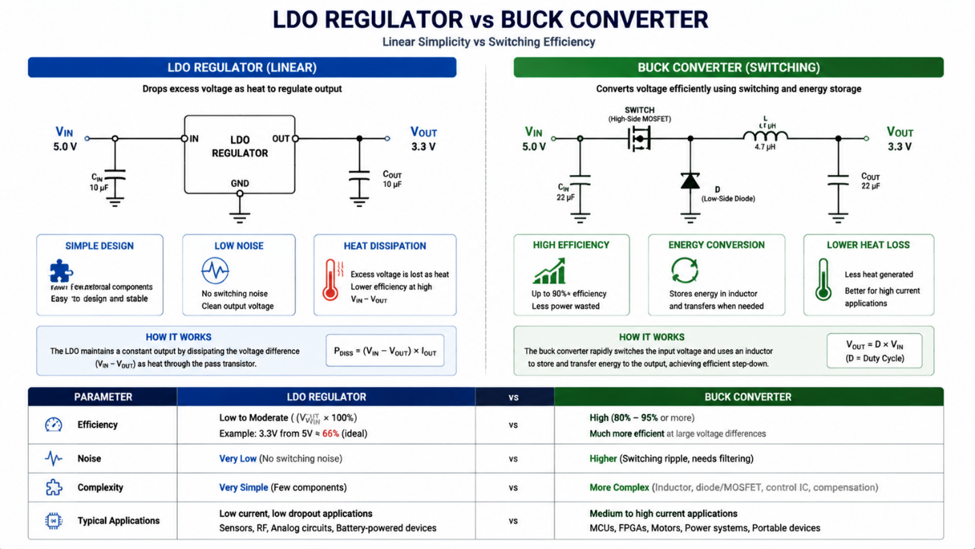
When an LDO Is the Better Choice
An LDO (Low Dropout Regulator) is a linear regulator that reduces voltage by dissipating excess energy as heat.
Although this creates efficiency limitations, LDOs have several advantages:
- Very simple circuit design.
- Low output noise.
- Small PCB area.
- Low component count.
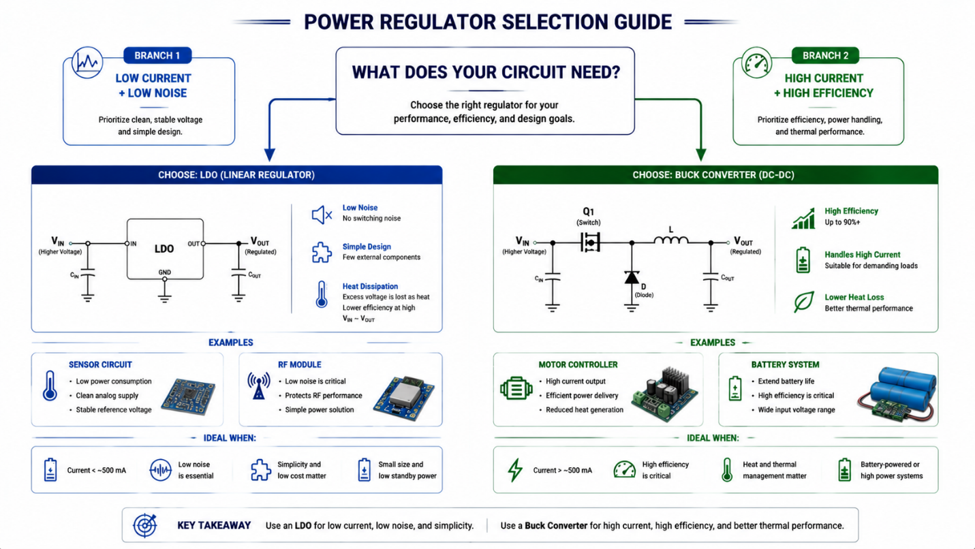
LDOs are commonly used for:
- Microcontroller power rails.
- Analog circuits.
- Sensor interfaces.
- RF circuits require clean voltage supply.
For low-current applications, the simplicity of an LDO often outweighs its lower efficiency.
When a Buck Converter Is Better
A buck converter uses switching technology to convert voltage efficiently.
Instead of wasting excess voltage as heat, it transfers energy through an inductor and switching components.
Advantages include:
- High efficiency.
- Lower heat generation.
- Suitable for higher current loads.
Typical applications:
- Battery-powered systems.
- Motor controllers.
- Industrial electronics.
- High-power embedded devices.
The trade-off is increased design complexity and potential switching noise.
Quick Comparison
| Feature | LDO | Buck Converter |
|---|---|---|
| Efficiency | Lower | Higher |
| Noise | Very Low | Higher Switching Noise |
| Circuit Complexity | Simple | More Complex |
| Heat Generation | Higher at Large Loads | Lower |
| PCB Area | Smaller | Larger |
Recommended Devices
| Device | Type | Typical Application |
|---|---|---|
| MCP1700 | LDO | Low-power MCU circuits |
| AMS1117 | LDO | Development boards |
| TPS62160 | Buck Converter | Compact embedded systems |
| MP1584 | Buck Converter | Adjustable DC power modules |
Engineering Tip
Do not choose a regulator only by efficiency. A sensitive analog sensor may perform better with a low-noise LDO, while a battery-powered motor system may require a high-efficiency buck converter.
LDO regulators and buck converters are not competing solutions. They are designed for different power requirements.
LDOs are ideal when simplicity, low noise, and small current consumption are priorities. Buck converters are better when efficiency and higher current capability are required.
Many modern products use both: a buck converter for efficient voltage conversion and an LDO afterward to provide a cleaner supply for sensitive circuits.
#PowerAndEnergy# #LDO# #BuckConverter# #PowerSupply# #PowerElectronics# #Electronics#
 #PowerAndEnergy#
#LDO#
#BuckConverter#
#PowerSupply#
#PowerElectronics#
#Electronics#
#PowerAndEnergy#
#LDO#
#BuckConverter#
#PowerSupply#
#PowerElectronics#
#Electronics#
Sign In Or Register Comment after
No comments yet. Be the first to comment!