


Thermistor vs RTD: Choosing the Right Temperature Sensor
 View
View
Temperature measurement is one of the most common requirements in electronic systems. From battery management systems and industrial machines to IoT devices and environmental monitoring, accurate temperature sensing is essential for safety and performance.
Two widely used temperature sensors are thermistors and RTDs (Resistance Temperature Detectors). Both measure temperature by detecting changes in electrical resistance, but their characteristics make them suitable for different applications.
Choosing the wrong sensor can result in inaccurate measurements, poor response time, or unnecessary system complexity.
How Thermistors Work
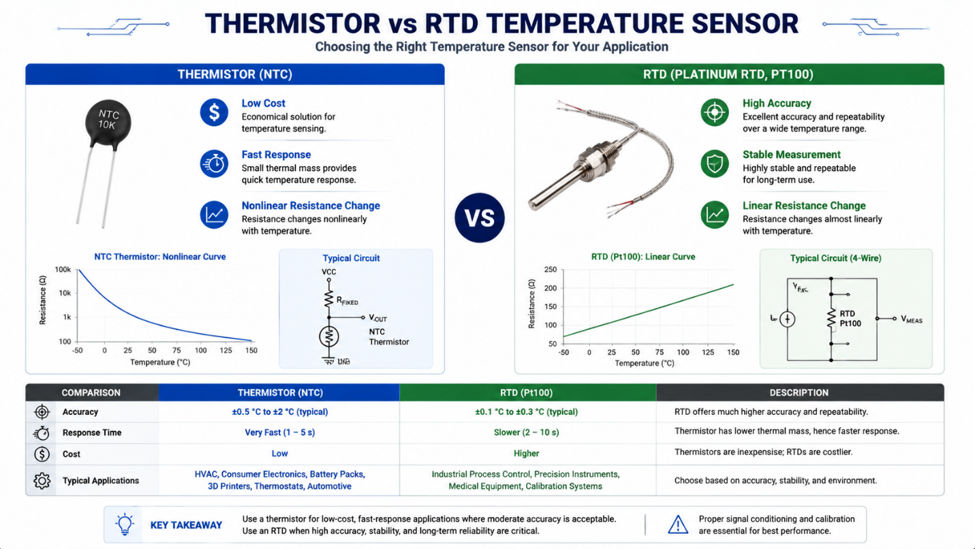
A thermistor is a temperature-sensitive resistor whose resistance changes significantly with temperature.
The most common type is an NTC (Negative Temperature Coefficient) thermistor, where resistance decreases as temperature increases.
Advantages:
- Low cost.
- Small size.
- Fast response.
- Simple interface circuit.
Because the resistance change is nonlinear, thermistors usually require calibration or software compensation for accurate temperature measurement.
Common applications include:
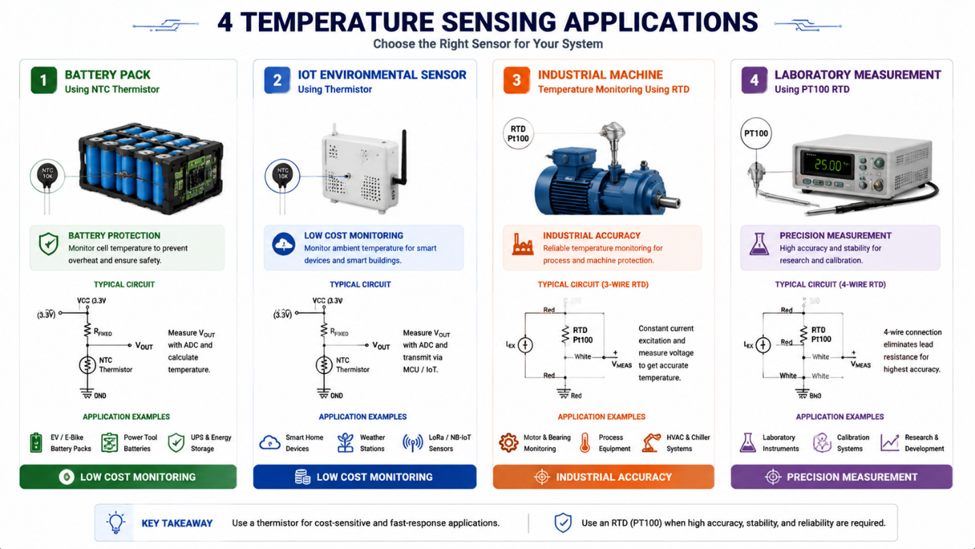
- Battery temperature monitoring.
- Consumer electronics.
- HVAC systems.
- Protection circuits.
How RTDs Work
RTDs use a metal element, commonly platinum, whose resistance changes predictably with temperature.
The most popular type is the PT100, which has a resistance of 100 Ω at 0°C.
Advantages:
- Excellent accuracy.
- High stability.
- Good long-term reliability.
- More linear response.
RTDs are widely used in industrial applications where accurate temperature measurement is more important than cost.
Typical applications:
- Industrial process control.
- Laboratory equipment.
- Precision Measurement Systems
Quick Comparison
| Feature | Thermistor | RTD |
|---|---|---|
| Accuracy | Moderate | High |
| Cost | Low | Higher |
| Linearity | Nonlinear | More Linear |
| Response Speed | Fast | Moderate |
| Typical Use | Consumer & Embedded | Industrial & Precision |
Engineering Note
A cheaper sensor with proper calibration can sometimes outperform an expensive sensor used without considering the measurement environment. Sensor selection should always match the required accuracy and application conditions.
Recommended Devices
| Device | Type | Typical Application |
|---|---|---|
| Murata NTC NCP Series | NTC Thermistor | Battery temperature sensing |
| TDK NTCG Series | NTC Thermistor | Consumer electronics |
| PT100 Class A RTD | Platinum RTD | Industrial temperature measurement |
| PT1000 RTD | Platinum RTD | Precision sensing systems |
Selection Guide
Choose a Thermistor when:
✓ Low cost is important.
✓ Fast response is required.
✓ Moderate accuracy is acceptable.
Choose an RTD when:
✓ High accuracy is required.
✓ Long-term stability matters.
✓ The environment is industrial or critical.
Thermistors and RTDs are both valuable temperature sensors, but they are optimized for different applications. Thermistors provide a simple and economical solution for many embedded products, while RTDs deliver higher accuracy and stability for industrial measurement systems.
The best sensor is not always the most expensive one, it is the sensor that matches the requirements of the system.
#SensorsAndActuators# #TemperatureSensor# #Thermistor# #RTD# #IndustrialAutomation# #Electronics#
 #SensorsAndActuators#
#TemperatureSensor#
#Thermistor#
#RTD#
#IndustrialAutomation#
#Electronics#
#SensorsAndActuators#
#TemperatureSensor#
#Thermistor#
#RTD#
#IndustrialAutomation#
#Electronics#
Sign In Or Register Comment after
No comments yet. Be the first to comment!