


SPI vs I2C: Choosing the Right Communication Interface for Your Sensor
 View
View
Modern embedded systems rarely operate with only a microcontroller and a few basic components. Sensors, displays, memory chips, and communication modules often need to exchange data with the main controller.
Two of the most common communication interfaces used for these devices are SPI (Serial Peripheral Interface) and I2C (Inter-Integrated Circuit).
Both are widely supported by microcontrollers, but they are designed with different priorities. SPI focuses on speed and simple communication, while I2C focuses on reducing wiring complexity by allowing multiple devices to share the same bus.
Selecting the correct interface can affect PCB layout, system reliability, and future expansion capability.
Understanding SPI Communication
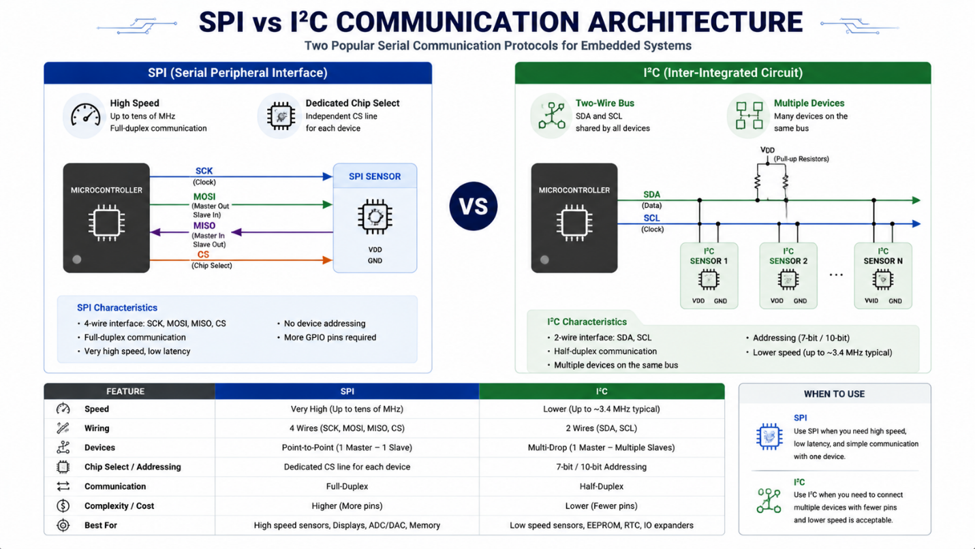
SPI uses a master-slave architecture where the controller communicates with peripheral devices using separate signal lines.
Typical SPI signals include:
- SCK (Clock)
- MOSI (Master Out Slave In)
- MISO (Master in Slave Out)
- CS (Chip Select)
The main advantage of SPI is speed. Because it uses separate data paths and does not require addressing, SPI can achieve high communication rates with low protocol overhead.
SPI is commonly used for:
- High-speed displays.
- SD card storage.
- Flash memory.
- Fast ADC modules.
The disadvantage is that each additional device usually requires an additional chip select line.
Understanding I2C Communication
I2C uses only two communication wires:
- SDA for data.
- SCL for clock.
Each device has its own address, allowing multiple peripherals to share the same bus.
This makes I2C very attractive for systems containing many low-speed sensors.
Common applications include:
- Temperature sensors.
- EEPROM memory.
- Real-time clocks.
- Environmental sensors.
The trade-off is lower speed compared with SPI and the need for proper pull-up resistor selection.
Quick Comparison
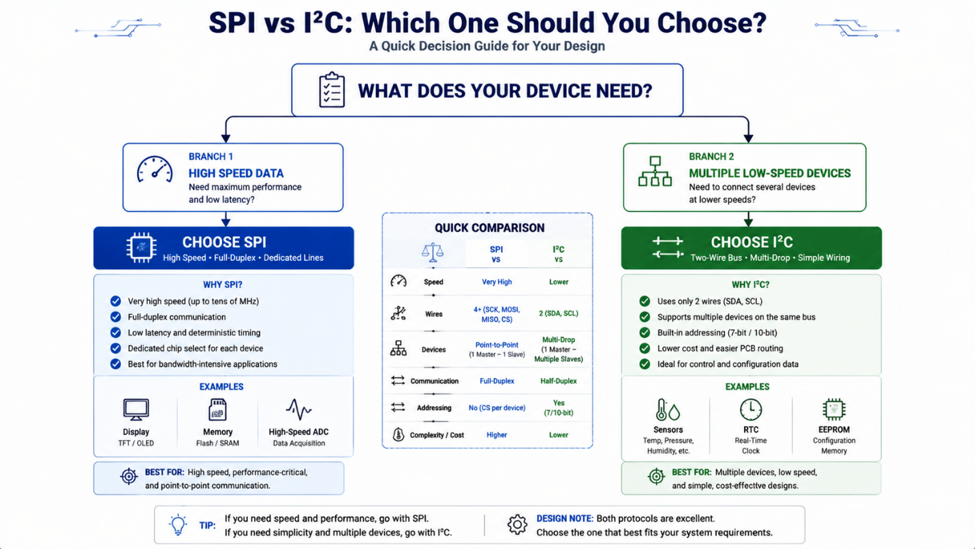
| Feature | SPI | I2C |
|---|---|---|
| Wires | More | Only Two |
| Speed | Higher | Lower |
| Multiple Devices | More Wiring | Easy Expansion |
| Protocol Complexity | Simple | More Structured |
| Common Use | Displays, Memory | Sensors, IC Modules |
Common Design Mistakes
Forgetting I2C Pull-up Resistors
I2C lines require pull-up resistors because devices use open-drain outputs.
Long SPI Connections Without Considering Signal Quality
Although SPI is fast, long traces can create signal integrity problems.
Ignoring Voltage Compatibility
Connecting a 5V peripheral directly to a 3.3V MCU without level shifting can damage components or create communication failures.
Recommended Devices
| Device | Interface | Typical Application |
|---|---|---|
| BME280 | I2C/SPI | Environmental sensing |
| MPU6050 | I2C | Motion sensing |
| W25Q64 Flash | SPI | External memory |
| ILI9341 Display | SPI | TFT display interface |
Engineering Tip
The fastest communication interface is not always the best choice. A simple two-wire I2C connection may be the better engineering decision when expanding a sensor network.
SPI and I2C are both powerful communication interfaces, but they solve different design challenges. SPI is ideal when speed is the priority, while I2C is better when simplicity and multiple device connections are more important.
Understanding the trade-offs before selecting a communication interface helps create embedded systems that are easier to build, debug, and expand.
#EmbeddedSystems# #SPI# #I2C# #CommunicationProtocol# #Microcontroller# #Electronics#
 #EmbeddedSystems#
#SPI#
#I2C#
#CommunicationProtocol#
#Microcontroller#
#Electronics#
#EmbeddedSystems#
#SPI#
#I2C#
#CommunicationProtocol#
#Microcontroller#
#Electronics#
Sign In Or Register Comment after
No comments yet. Be the first to comment!