


Why Reverse Polarity Protection Is Important in Every Power Input
 View
View
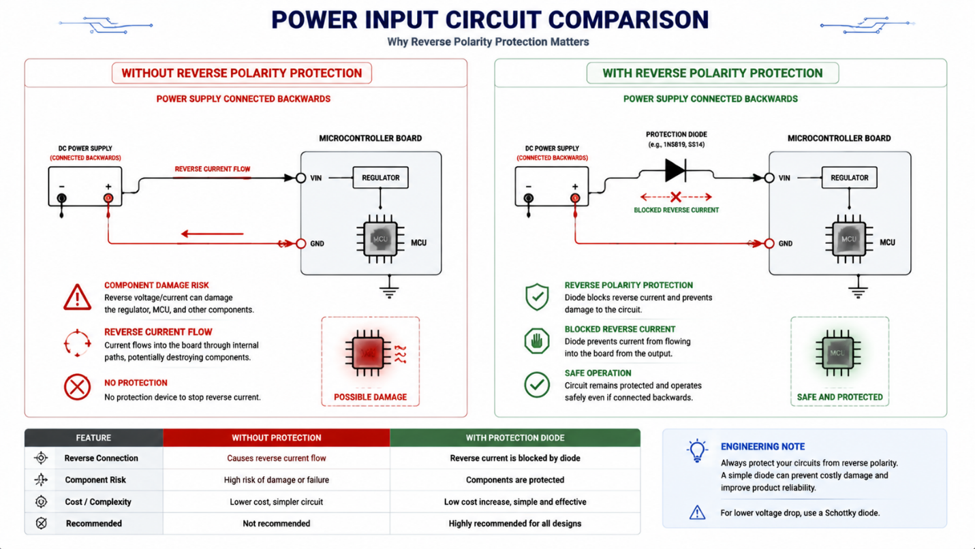
Connecting a power supply with the wrong polarity is one of the simplest mistakes that can happen during electronics development. A reversed connection may happen because of incorrect wiring, damaged connectors, assembly mistakes, or user error.
Without protection, reverse polarity can instantly damage sensitive components such as microcontrollers, sensors, communication modules, and power management ICs.
For this reason, many professional electronic products include a protection circuit at the power input stage. This small addition can significantly improve product reliability and prevent costly failures during testing and operation.
Why Reverse Polarity Can Damage Electronics
Electronic components are designed to operate with a specific voltage direction.
When the supply polarity is reversed:
- Semiconductor junctions may become forward biased.
- Excessive current can flow through components.
- Integrated circuits may be permanently damaged.
- Capacitors may experience incorrect voltage stress.
Even a short reverse connection during testing can destroy expensive components.
Common Protection Methods
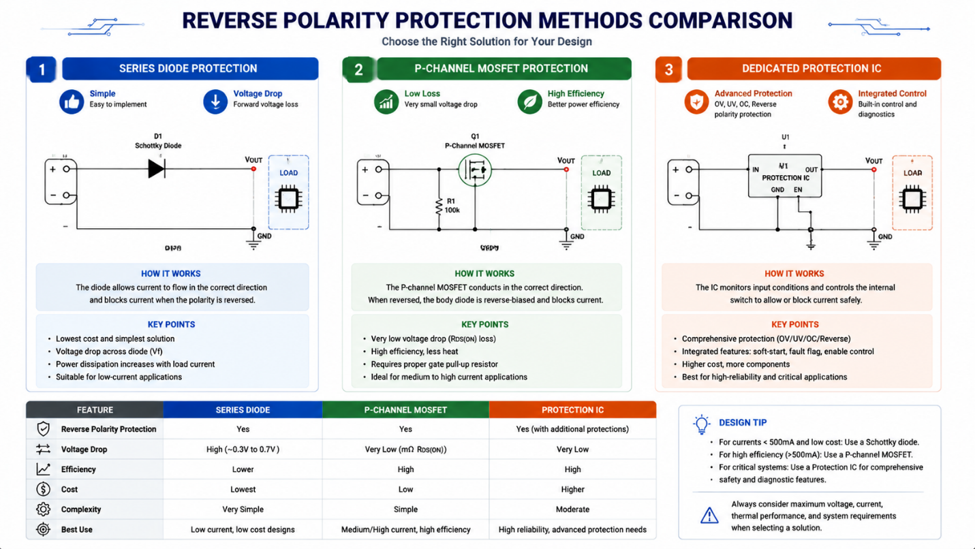
1. Series Diode Protection
The simplest method is placing a diode in series with power input.
When connected correctly, the diode allows current flow. When polarity is reversed, it blocks the current.
Advantages:
- Simple design.
- Low cost.
- Easy implementation.
Disadvantages:
- Forward voltage drop reduces the available supply voltage.
2. P-Channel MOSFET Protection
A MOSFET-based solution can provide lower voltage loss compared with a diode.
When polarity is correct, the MOSFET turns on and behaves like a very low resistance switch.
Advantages:
- Very low voltage drops.
- Higher efficiency.
- Suitable for battery-powered systems.
Selecting the Right Protection Method
The best solution depends on the application.
For simple low-current circuits:
- A diode may be sufficient.
For battery-powered devices:
- MOSFET protection is usually preferred because every voltage drop reduces battery efficiency.
For industrial products:
- Dedicated protection ICs may provide additional features such as overvoltage protection and current limiting.
Recommended Devices
| Device | Type | Typical Application |
|---|---|---|
| SS14 Schottky Diode | Reverse Protection Diode | Low-current electronics |
| IRLML6402 | P-Channel MOSFET | Battery-powered circuits |
| TPS26600 | Protection IC | Industrial power input |
| LTC4365 | Surge Protector | Advanced power protection |
Engineering Note
A protection circuit is cheapest before a failure happens. Adding a few cents of protection components during design can prevent losing an entire PCB during testing.
Practical Checklist
Before finalizing a power input design:
✓ Is reverse polarity protection included?
✓ Can the protection component handle the maximum current?
✓ Is voltage drop acceptable?
✓ Is heat dissipation considered?
✓ Does the protection work during startup conditions?
Reverse polarity protection is a small design detail that can make a significant difference in product reliability. Whether using a simple diode, a MOSFET solution, or a dedicated protection IC, adding protection at the power input stage helps prevent accidental damage and improves the robustness of electronic products.
Good engineering is not only about making a circuit work correctly, but also about making real-world mistakes.
#PowerAndEnergy# #CircuitProtection# #ReversePolarity# #MOSFET# #PowerDesign# #Electronics#
 #PowerAndEnergy#
#CircuitProtection#
#ReversePolarity#
#MOSFET#
#PowerDesign#
#Electronics#
#PowerAndEnergy#
#CircuitProtection#
#ReversePolarity#
#MOSFET#
#PowerDesign#
#Electronics#
Sign In Or Register Comment after
No comments yet. Be the first to comment!