


Relay vs Contactor: When Should You Use Each One?
 View
View
Switching electrical loads is one of the most common requirements in automation and control systems. From turning on a small sensor circuit to controlling industrial motors, engineers need a reliable method to isolate and control electrical power.
Two components that are often confused are relays and contactors. Both use electromagnetic operation to switch circuits, but they are designed for different power levels and applications.
Using the wrong device can lead to contact damage, overheating, reduced lifetime, or even unsafe operation.
Understanding the difference between relays and contactors helps engineers select the correct switching solution for their system.
How Relays Work
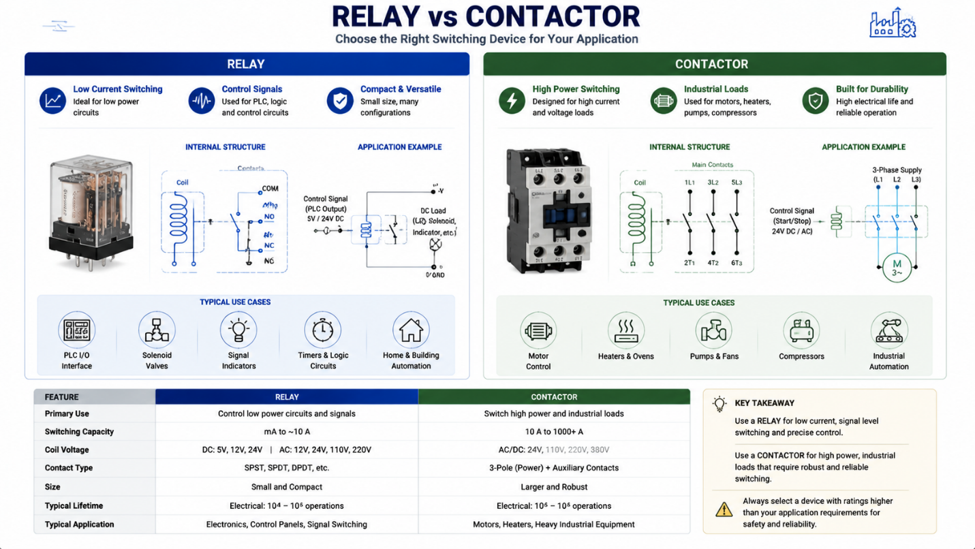
A relay uses an electromagnetic coil to mechanically open or close electrical contacts.
Relays are commonly used when a low-voltage control signal needs to switch to another electrical circuit while maintaining isolation.
Typical applications include:
- Microcontroller-controlled switching.
- Small motors.
- Solenoid valves.
- Lighting control.
- General-purpose automation.
Relays are compact, inexpensive, and easy to control using electronic circuits.
However, they are usually not designed for frequent switching of large electrical loads.
How Contactors Work
Contactors operate using the same electromagnetic principle but are designed specifically for higher current applications.
They are commonly used in:
- Three-phase motors.
- Industrial heaters.
- Large pumps.
- HVAC systems.
- Factory automation equipment.
Contactors usually include features such as:
- Higher current ratings.
- Arc suppression.
- Mechanical durability.
- Auxiliary contacts for monitoring.
Because of these features, contactors are better suited for demanding industrial environments.
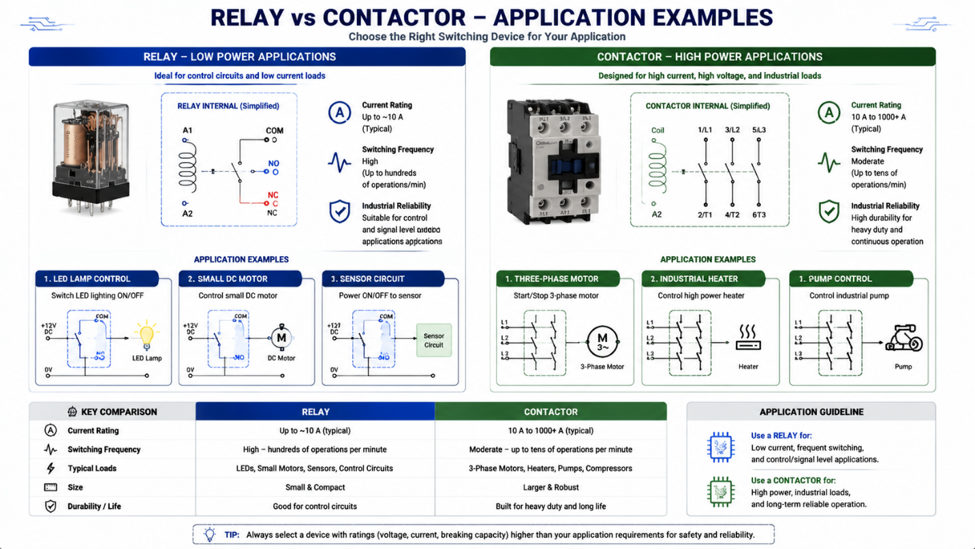
Quick Comparison
| Feature | Relay | Contactor |
|---|---|---|
| Typical Current | Low to Medium | Medium to High |
| Main Use | Control Circuits | Power Loads |
| Size | Compact | Larger |
| Switching Frequency | Moderate | Industrial Duty |
| Common Application | Electronics | Automation Systems |
Engineering Note
A relay can switch a motor, but that does not always mean it should. Motor starting current can be several times higher than normal operating current, requiring a switching device designed for that stress.
Recommended Devices
| Device | Type | Typical Application |
|---|---|---|
| Omron G2R Series | Relay | Control circuits |
| Songle SRD Series | Relay | Hobby and embedded projects |
| Schneider TeSys Series | Contactor | Industrial motor control |
| Siemens SIRIUS Series | Contactor | Factory automation |
Selection Guide
Choose a Relay when:
✓ Switching current is relatively small.
✓ The circuit is controlled by a microcontroller or PLC output.
✓ Compact size and low cost are important.
Choose a Contactor when:
✓ Controlling motors or high-power loads.
✓ High switching durability is required.
✓ Industrial safety and reliability are priorities.
Relays and contactors are both important switching components, but they serve different purposes. Relays are ideal for low and medium-power control applications, while contactors are designed for reliable switching of larger industrial loads.
Selecting the correct device improves system reliability, extends component lifetime, and prevents unnecessary failures in electrical control systems.
#IndustrialAutomation# #Relay# #Contactor# #MotorControl# #ElectricalEngineering# #Electronics#
 #IndustrialAutomation#
#Relay#
#Contactor#
#MotorControl#
#ElectricalEngineering#
#Electronics#
#IndustrialAutomation#
#Relay#
#Contactor#
#MotorControl#
#ElectricalEngineering#
#Electronics#
Sign In Or Register Comment after
No comments yet. Be the first to comment!