


When Do You Need a Logic Level Shifter?
 View
View
Modern electronic systems often combine components that operate at different supply voltages. For example, a microcontroller may use 3.3V logic, while a sensor, display, or legacy module operates at 5V. Connecting these devices directly may seem to work during initial testing, but it can lead to unreliable communication or even permanent damage.
This is where a logic level shifter becomes important. A level shifter safely translates digital signals between different voltage domains, allowing devices with incompatible logic levels to communicate correctly.
Understanding when a level shifter is required can prevent many common hardware problems during embedded system development.
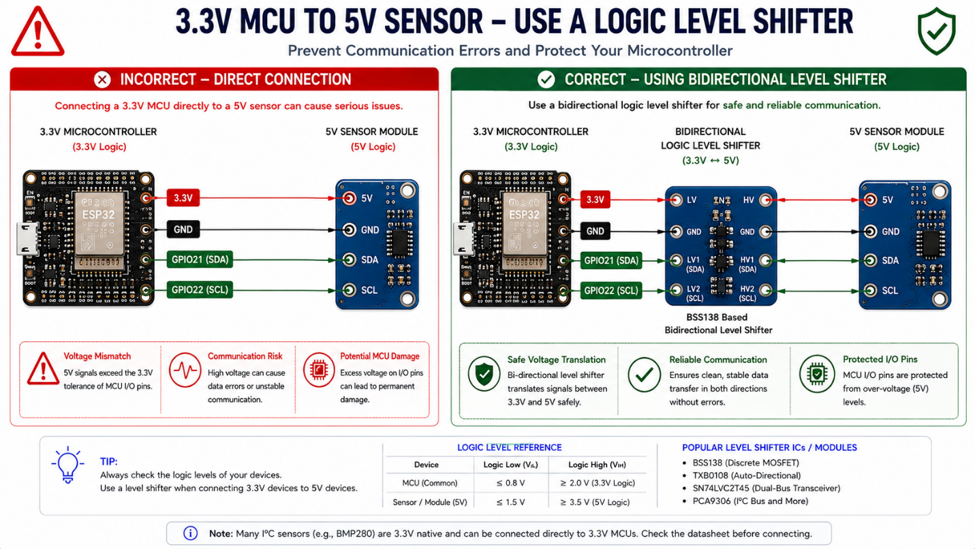
Why Voltage Levels Matter
Digital circuits determine logic HIGH and LOW based on voltage thresholds.
A 5V output connected directly to a 3.3V microcontroller input may exceed the maximum input voltage rating, potentially damaging the device. On the other hand, some 3.3V outputs may not be recognized as a valid HIGH level by older 5V logic devices.
Because every device has its own electrical specifications, always check the datasheet before connecting different logic families together.
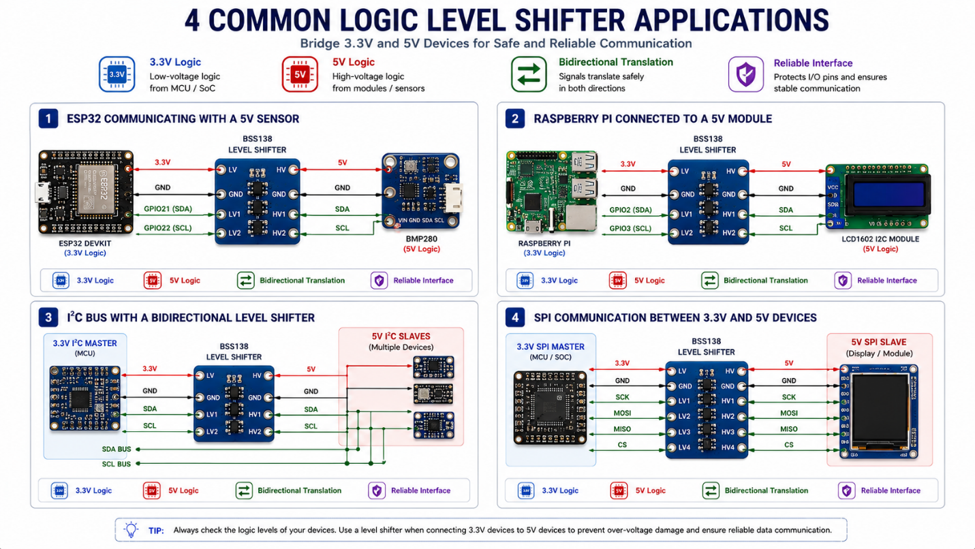
Common Applications
Logic level shifters are widely used in embedded systems, including:
- ESP32 communicates with 5V peripherals.
- Raspberry Pi connected to legacy modules.
- I²C communication between 3.3V and 5V devices.
- SPI interfaces with mixed-voltage components.
- UART communication between different development boards.
Although some devices are already 5V tolerant, many modern microcontrollers are not.
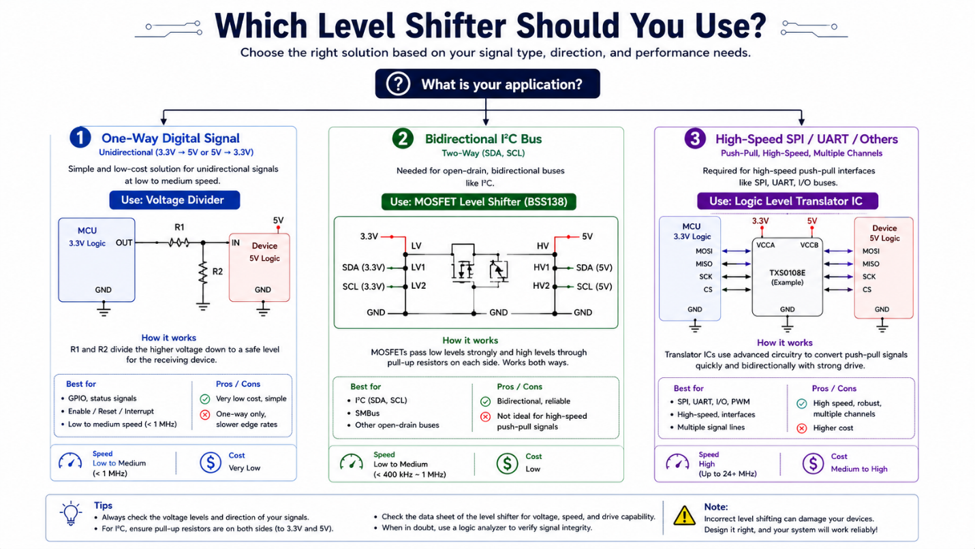
Common Level Shifting Methods
Different applications require different approaches.
- Resistor Voltage Divider – Suitable for one-way, lower-speed signals.
- MOSFET-Based Level Shifter – Common for bidirectional I²C communication.
- Dedicated Logic Level Translator IC – Best for high-speed digital interfaces.
Choosing the right solution depends on signal direction, communication speed, and interface type.
Engineering Note
A voltage divider works well for simple one-way signals, but it is not a universal replacement for a dedicated logic level shifter. Bidirectional buses such as I²C require circuits specifically designed for two-way communication.
Recommended Devices
| Device | Type | Typical Application |
|---|---|---|
| BSS138 Level Shifter Module | MOSFET-Based | I²C and GPIO translation |
| TXS0108E | Bidirectional Level Translator | General-purpose digital interfaces |
| TXB0104 | High-Speed Level Translator | SPI and UART communication |
| 74LVC245A | Bus Transceiver | High-speed embedded systems |
Logic level shifters are simple components that solve an important compatibility problem in mixed-voltage systems. By matching logic levels correctly, engineers can improve communication reliability and protect sensitive microcontroller pins from excessive voltage.
Before connecting two digital devices together, always verify whether they share the same logic voltage or whether a level shifter should be part of the design.
#ElectronicComponents# #LogicLevelShifter# #EmbeddedSystems# #Microcontroller# #DigitalElectronics# #Electronics#
 #ElectronicComponents#
#LogicLevelShifter#
#EmbeddedSystems#
#Microcontroller#
#DigitalElectronics#
#Electronics#
#ElectronicComponents#
#LogicLevelShifter#
#EmbeddedSystems#
#Microcontroller#
#DigitalElectronics#
#Electronics#
Sign In Or Register Comment after
No comments yet. Be the first to comment!