


MQTT vs HTTP: Which Communication Protocol Is Better for IoT?
 View
View
Every IoT device needs a way to exchange data with other systems. Whether it's a temperature sensor sending readings to the cloud or a smart switch receiving remote commands, the communication protocol plays a major role in determining system performance.
Two of the most used protocols are MQTT and HTTP. Both allow devices to communicate over a network, but they are designed with different goals in mind.
HTTP is widely used for web applications and REST APIs, while MQTT was developed specifically for lightweight machine-to-machine communication. Understanding their differences helps engineers build IoT systems that are efficient, reliable, and scalable.
Understanding HTTP
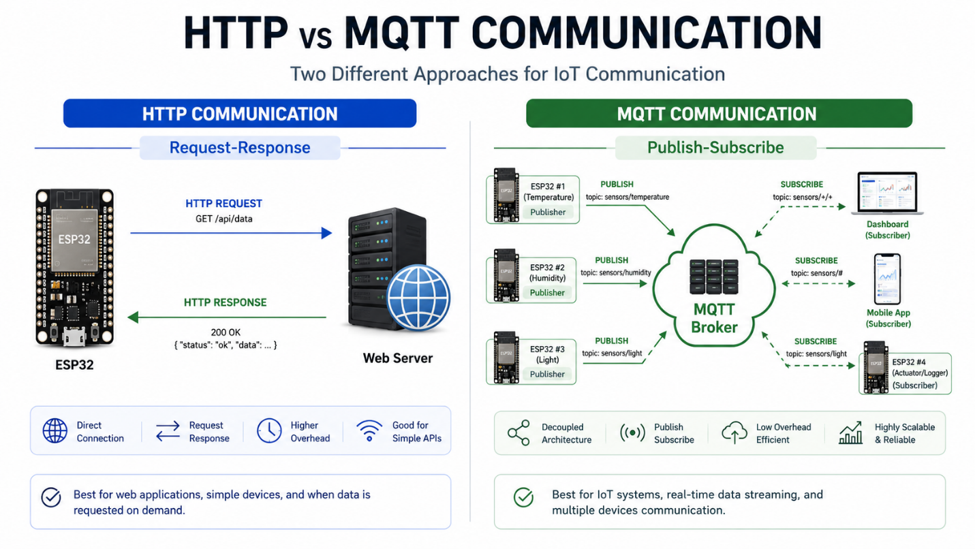
HTTP follows a request-response model. A client sends a request to a server, and the server returns the requested data.
This approach is ideal for:
- Web dashboards.
- REST APIs.
- Device configuration.
- Firmware downloads.
- Applications that only require occasional communication.
The simplicity of HTTP makes it easy to implement, but frequent requests can increase bandwidth usage and power consumption.
Understanding MQTT
MQTT uses a publish-subscribe model managed by a broker.
Instead of communicating directly with each other, devices publish data to topics, while other devices subscribe to the topics they need.
This architecture offers several advantages:
- Lower bandwidth usage.
- Reduced network overhead.
- Efficient communication with many devices.
- Better support for unstable network connections.
For these reasons, MQTT is widely used in smart home systems, industrial IoT, and remote monitoring applications.
Quick Comparison
| Feature | MQTT | HTTP |
|---|---|---|
| Communication Model | Publish–Subscribe | Request–Response |
| Network Overhead | Low | Higher |
| Bandwidth Usage | Efficient | Moderate |
| Real-Time Updates | Excellent | Limited |
| Typical Applications | IoT, Smart Home, Industrial Monitoring | Web Services, REST APIs, Configuration |
Recommended Platforms
| Platform | Protocol | Typical Application |
|---|---|---|
| Mosquitto | MQTT | Self-hosted broker |
| HiveMQ | MQTT | Enterprise IoT |
| EMQX | MQTT | Large-scale IoT deployments |
| Node-RED | HTTP & MQTT | IoT integration and automation |
Engineering Note
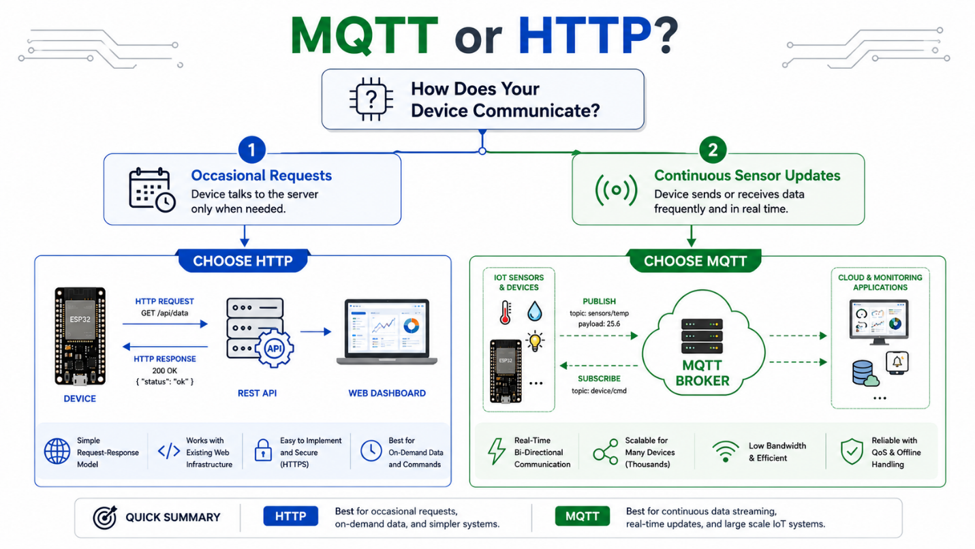
Choosing MQTT does not automatically make an IoT system better. If your device only sends configuration data occasionally, HTTP may be simpler to implement and easier to integrate with existing web services.
Both MQTT and HTTP are valuable communication protocols for IoT systems, but they serve different purposes. HTTP is a straightforward choice for web-based applications and occasional data exchange, while MQTT excels in continuous, low-bandwidth communication between multiple devices.
Selecting the right protocol should be based on how your devices communicate, not simply on which technology is more popular.
#WirelessAndIoT# #MQTT# #HTTP# #IoT# #ESP32# #Electronics#
 #WirelessAndIoT#
#MQTT#
#HTTP#
#IoT#
#ESP32#
#Electronics#
#WirelessAndIoT#
#MQTT#
#HTTP#
#IoT#
#ESP32#
#Electronics#
Sign In Or Register Comment after
No comments yet. Be the first to comment!