


Hall Sensor vs Optical Encoder: Understanding the Difference in Motion Sensing
 View
View
Motion sensing is essential in many electronic systems, from cooling fans and conveyor belts to CNC machines and robotic arms. Two common technologies used to detect rotation are Hall sensors and optical encoders.
Although both can measure movement, they operate using different principles and are suited to different applications. Choosing the right sensing technology can improve system accuracy, reliability, and cost efficiency.
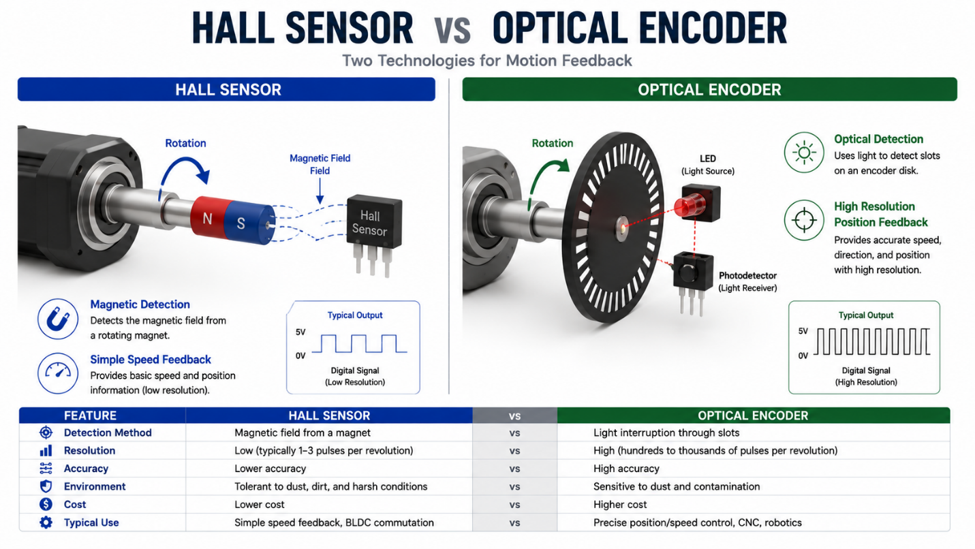
How Hall Sensors Work
A Hall sensor detects changes in a magnetic field. When a magnet attached to a rotating shaft passes the sensor, it generates an electrical pulse.
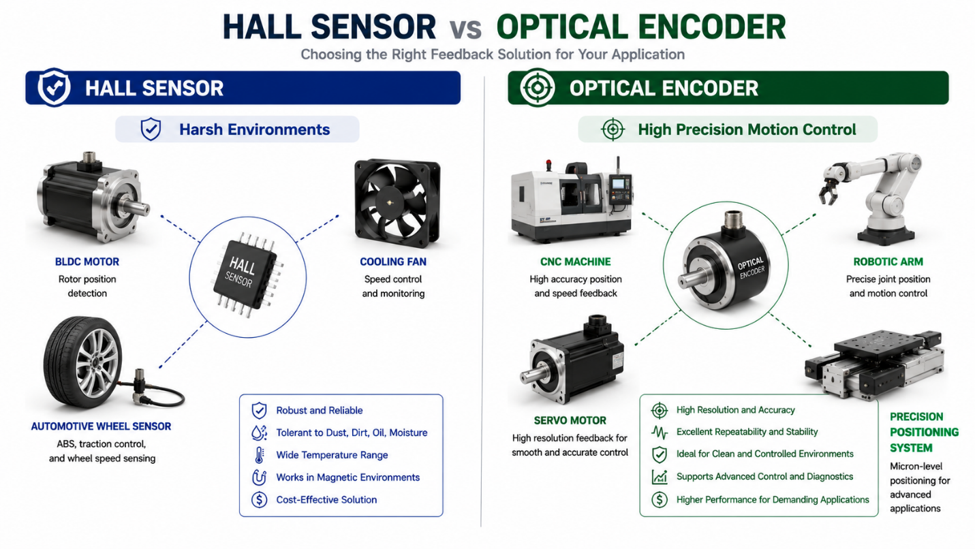
Hall sensors are commonly used for:
- Brushless DC motor commutation
- Cooling fan speed monitoring
- Wheel speed sensing
- Basic RPM measurement
Because they have no optical path to block, Hall sensors perform well in dusty, oily, or humid environments.
How Optical Encoders Work
An optical encoder uses a light source and a photodetector. As a slotted or patterned disk rotates, light is alternately blocked and transmitted, producing pulses that represent shaft movement.
Optical encoders are ideal for applications requiring:
- High positional accuracy
- Fine speed measurement
- CNC machinery
- Robotics
- Precision motion control
However, they are generally more sensitive to dust and contamination than Hall-based solutions.
Quick Comparison
| Feature | Hall Sensor | Optical Encoder |
|---|---|---|
| Detection Method | Magnetic field | Light interruption |
| Position Resolution | Low to Medium | High |
| Dust Resistance | Excellent | Moderate |
| Cost | Lower | Higher |
| Typical Use | Speed sensing | Position and motion control |
Recommended Components
| Component | Application | Key Feature |
|---|---|---|
| A3144 Hall Sensor | RPM detection | Simple digital output |
| DRV5055 | Magnetic field sensing | Analog Hall sensor |
| Omron E6B2 Encoder | Industrial automation | Incremental optical encoder |
| Autonics E40 Series | Motion control | High-resolution rotary encoder |
Engineering Tip
If your application only needs rotational speed, a Hall sensor is often the simplest and most cost-effective solution. For precise positioning or closed-loop motion control, an optical encoder provides significantly higher resolution and accuracy.
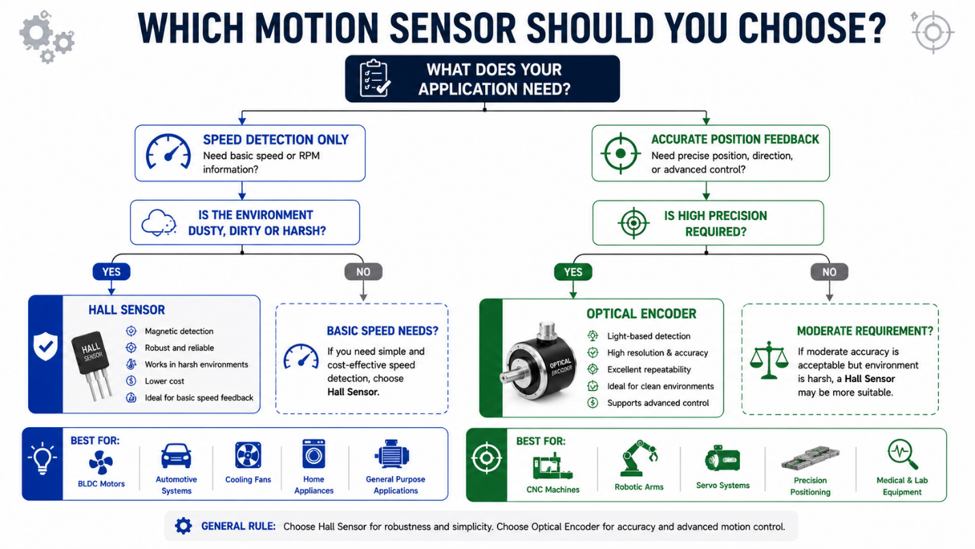
Hall sensors and optical encoders both play important roles in motion sensing, but they solve different engineering problems. Hall sensors offer a rugged, low-cost solution for speed detection, while optical encoders deliver the precision needed for advanced motion control.
By matching the sensing technology to the application's requirements, engineers can achieve the right balance between performance, reliability, and cost.
#SensorsAndActuators# #HallSensor# #OpticalEncoder# #MotionControl# #IndustrialAutomation# #Electronics#
 #SensorsAndActuators#
#HallSensor#
#OpticalEncoder#
#MotionControl#
#IndustrialAutomation#
#Electronics#
#SensorsAndActuators#
#HallSensor#
#OpticalEncoder#
#MotionControl#
#IndustrialAutomation#
#Electronics#
Sign In Or Register Comment after
No comments yet. Be the first to comment!