


Logic-Level MOSFET vs Standard MOSFET: Why Gate Voltage Matters
 View
View
Many engineers assume that any N-channel MOSFET can be driven directly from a microcontroller. After all, if the GPIO outputs 3.3 V or 5 V, shouldn't that be enough to turn the MOSFET on?
Unfortunately, that's not always the case.
A common design mistake is using a standard power MOSFET with a low-voltage microcontroller, expecting it to switch efficiently. While the MOSFET may appear to work, it often operates with higher resistance, generating unnecessary heat and reducing efficiency.
Understanding the difference between a logic-level MOSFET and a standard MOSFET helps engineers select the right device for reliable switching.
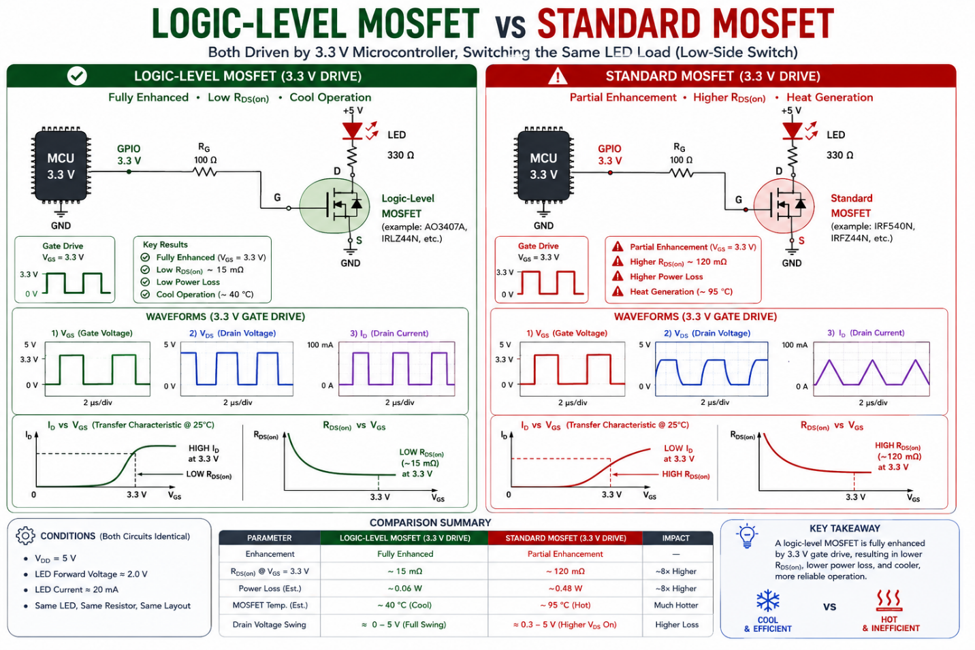
Understanding Gate Voltage
The gate of a MOSFET is voltage-controlled. However, the gate threshold voltage (VGS(th)) listed in the datasheet is often misunderstood.
The threshold voltage only indicates the point where the MOSFET begins to conduct a very small current. It does **not **mean the device is fully turned on.
To achieve the low RDS(on) specified in the datasheet, many standard MOSFETs require a gate voltage of around 10 V. If they are driven with only 3.3 V or 5 V, conduction losses increase significantly.
Why Logic-Level MOSFETs Are Different
Logic-level MOSFETs are specifically designed to provide low ON resistance with gate voltages commonly available from microcontrollers.
They are ideal for applications such as:
- Arduino-based projects
- ESP32 and ESP8266 systems
- STM32 development boards
- Raspberry Pi GPIO outputs
- Battery-powered embedded devices
Choosing the correct MOSFET improves efficiency and reduces unnecessary heating.

Practical Selection Tips
Before selecting a MOSFET, check the datasheet for:
- RDS(on) specified at your actual gate voltage.
- Maximum drain current.
- Power dissipation rating.
- Package thermal performance.
- Switching speed if PWM control is used.
Never select a MOSFET based solely on its maximum current rating.
Recommended Components
| Component | Application | Key Feature |
|---|---|---|
| IRLZ44N | Arduino power switching | Logic-level gate drive |
| AO3400A | Compact embedded systems | Low RDS(on) at 2.5–4.5 V |
| IRLML6344 | Battery-powered electronics | Low gate voltage operation |
| FQP30N06L | Medium-power switching | Logic-level N-channel MOSFET |
Engineering Tip
Ignore the gate threshold voltage when deciding whether a MOSFET is suitable for your design. Instead, verify the RDS(on) specification at the gate voltage your circuit provides.

Logic-level MOSFETs and standard MOSFETs may look similar, but they are optimized for different gate drive voltages. Selecting the wrong device can lead to excessive heat, poor efficiency, and unreliable operation even when the load current is well within specifications.
By reviewing the datasheet carefully and matching the MOSFET to the available gate voltage, engineers can build switching circuits that are both efficient and reliable.
#PowerAndEnergy# #MOSFET# #LogicLevelMOSFET# #PowerElectronics# #EmbeddedSystems# #CircuitDesign#
 #PowerAndEnergy#
#MOSFET#
#LogicLevelMOSFET#
#PowerElectronics#
#EmbeddedSystems#
#CircuitDesign#
#PowerAndEnergy#
#MOSFET#
#LogicLevelMOSFET#
#PowerElectronics#
#EmbeddedSystems#
#CircuitDesign#
Sign In Or Register Comment after
No comments yet. Be the first to comment!