


Why MOSFET Gate Resistors Matter More Than You Think
 View
View
When designing MOSFET switching circuits, many engineers focus on current ratings, RDS(on), and thermal performance. However, one small component is often overlooked—the gate resistor.
Since the MOSFET gate behaves like a capacitor, charging and discharging it instantly can create large current spikes, excessive ringing, and electromagnetic interference (EMI). A simple gate resistor helps control these effects and improves switching reliability.
Although some low-speed applications can operate without one, adding a properly selected gate resistor is considered good engineering practice in many designs.
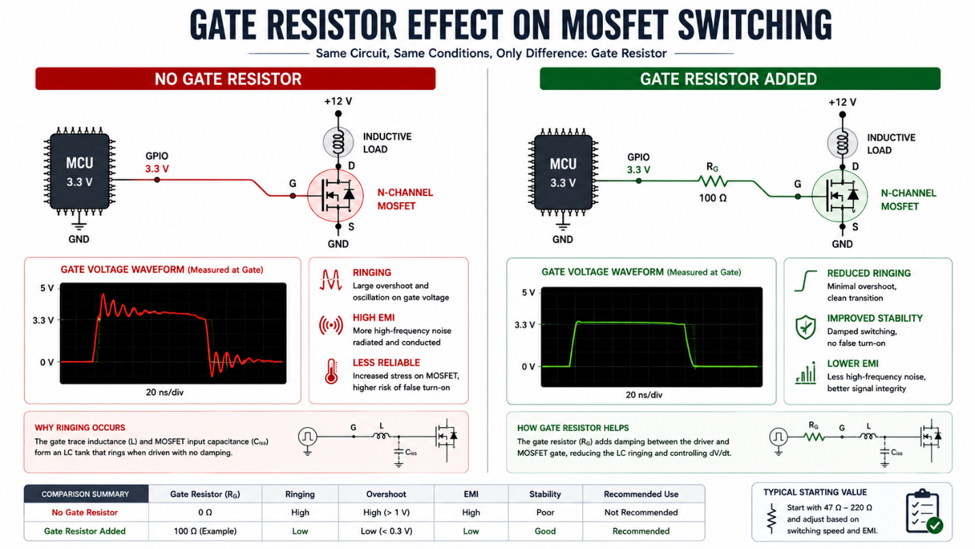
Why the Gate Behaves Like a Capacitor
Unlike a BJT, a MOSFET does not require continuous gate current to remain ON.
Instead, the gate must be charged and discharged whenever the MOSFET changes state. During switching, this charging current can momentarily become quite large, especially with power MOSFETs that have significant gate capacitance.
A gate resistor limits this peak current and makes the switching transition more controlled.
Finding the Right Balance
A resistor that is too small allows very fast switching, which may increase ringing and EMI.
A resistor that is too large slows the switching process excessively, increasing switching losses because the MOSFET spends more time in its linear region.
For many embedded applications, values between 10 Ω and 100 Ω provide a good starting point, although the optimal value depends on the MOSFET, gate driver, and switching frequency.

When Is a Gate Resistor Most Important?
A gate resistor becomes especially valuable in applications such as:
- PWM motor control
- Switching power supplies
- High-current MOSFET drivers
- Long PCB traces between the driver and MOSFET
- High-frequency switching circuits
These systems benefit from improved signal integrity and reduce electromagnetic noise.
Recommended Components
| Component | Application | Key Feature |
|---|---|---|
| 22 Ω Resistor | General MOSFET gate drive | Fast, controlled switching |
| 47 Ω Resistor | Embedded PWM applications | Good balance of speed and stability |
| 100 Ω Resistor | Sensitive circuits | Lower EMI and reduced ringing |
| TC4420 Gate Driver | High-speed switching | High peak gate current capability |
Engineering Tip
If you observe ringing on the MOSFET gate using an oscilloscope, don't immediately blame the PCB layout. A properly selected gate resistor is often enough to significantly improve waveform quality and reduce EMI.
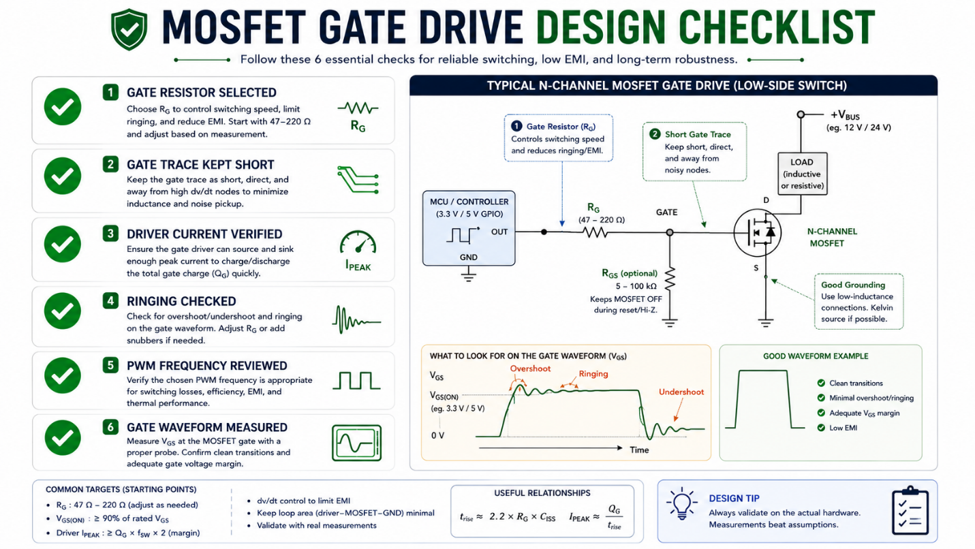
The gate resistor is a small and inexpensive component, but it has a significant impact on switching performance. By controlling gate charging current, reducing ringing, and minimizing EMI, it helps create more reliable MOSFET circuits.
Rather than treating it as an optional component, engineers should consider the gate resistor an important part of a well-designed switching circuit.
#PowerAndEnergy# #MOSFET# #GateResistor# #PowerElectronics# #EMI# #CircuitDesign#
 #PowerAndEnergy#
#MOSFET#
#GateResistor#
#PowerElectronics#
#EMI#
#CircuitDesign#
#PowerAndEnergy#
#MOSFET#
#GateResistor#
#PowerElectronics#
#EMI#
#CircuitDesign#
Sign In Or Register Comment after
No comments yet. Be the first to comment!