


Why Every Inductive Load Needs a Flyback Diode
 View
View
Many engineers successfully switch relays, solenoids, and DC motors using a transistor or MOSFET, only to discover that the switching device suddenly fails after repeated operation.
The culprit is often not excessive current, but the high-voltage spike generated when an inductive load is switched off.
A simple flyback diode can safely dissipate this stored energy, protecting switching devices and improving the long-term reliability of the circuit.
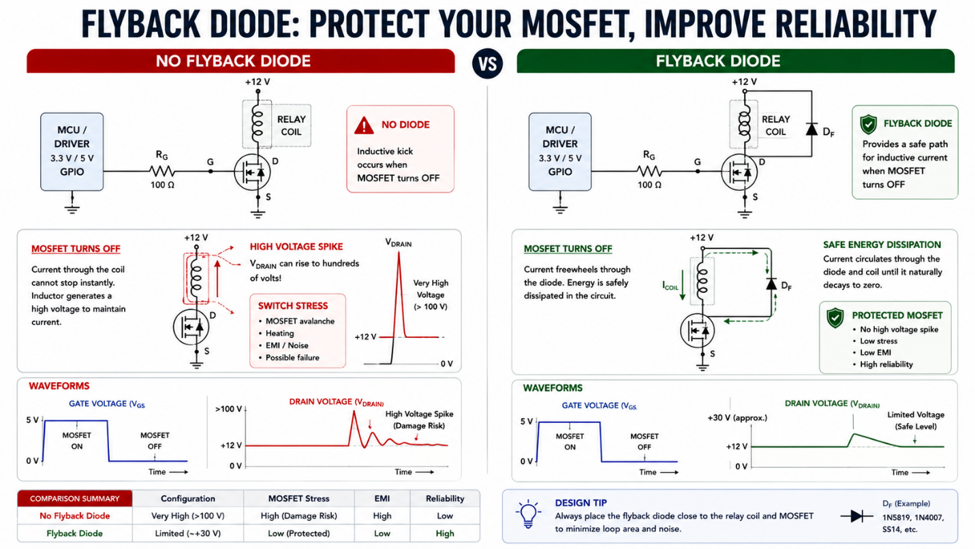
Why Voltage Spikes Occur
An inductor stores energy in its magnetic field while current flows through it.
When the current is interrupted, the magnetic field collapses rapidly. The inductor attempts to keep the current flowing, generating a high voltage in the opposite polarity.
This voltage can easily exceed the maximum rating of a transistor or MOSFET, even when the supply voltage is relatively low.
Without proper protection, repeated switching may gradually damage the switching device.
How a Flyback Diode Works
A flyback diode is connected in parallel with the inductive load, normally remaining reverse-biased during normal operation.
When the switching device turns off and the coil generates a reverse voltage, the diode becomes forward-biased, providing a safe path for the current to continue circulating until the stored energy is dissipated.
This greatly reduces voltage spikes and protects the switching device.
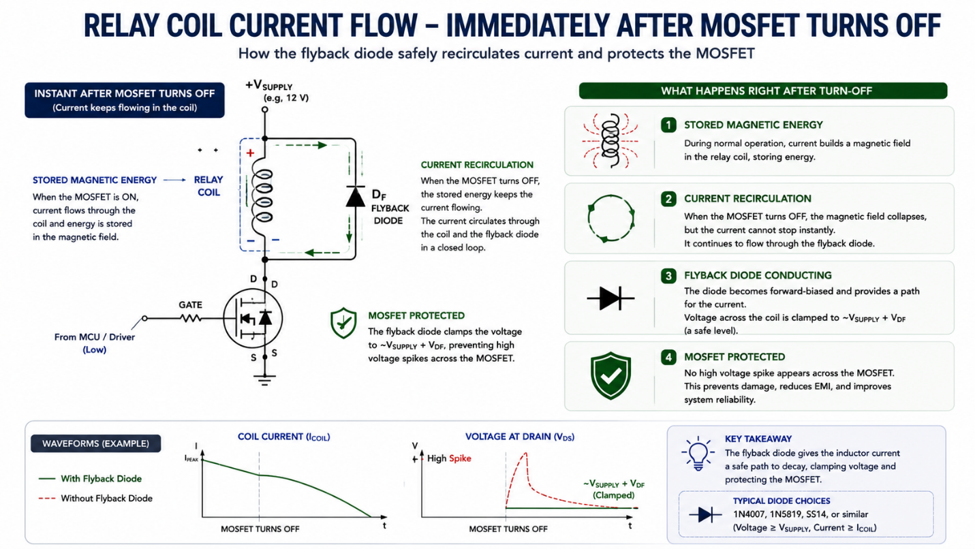
Choosing the Right Diode
For many low-frequency applications, common rectifier diodes such as the 1N4007 work well.
For higher switching frequencies, such as PWM motor control, fast recovery or Schottky diodes are often preferred because they switch more quickly and reduce power losses.
When selecting a flyback diode, verify:
- Reverse voltage rating
- Forward current rating
- Recovery speed for the application
- Package suitable for the expected power dissipation
Recommended Components
| Component | Application | Key Feature |
|---|---|---|
| 1N4007 | Relay and solenoid protection | General-purpose rectifier |
| UF4007 | Faster switching circuits | Ultra-fast recovery |
| SS34 | Low-voltage DC applications | Schottky diode with low forward voltage |
| SB560 | High-current inductive loads | High current capability |
Engineering Tip
Place the flyback diode physically close to the relay coil or inductive load rather than near the MOSFET. This minimizes the loop area carrying the transient current and improves noise suppression.

Whenever an inductive load is switched, stored magnetic energy must be safely released. A flyback diode provides a simple, inexpensive, and highly effective method of protecting transistors and MOSFETs from damaging voltage spikes.
Although it is a small component, including a flyback diode is one of the easiest ways to improve the reliability and lifespan of relay drivers, motor controllers, and other inductive switching circuits.
#PowerAndEnergy# #FlybackDiode# #MOSFET# #Relay# #PowerElectronics# #CircuitProtection#
 #PowerAndEnergy#
#FlybackDiode#
#MOSFET#
#Relay#
#PowerElectronics#
#CircuitProtection#
#PowerAndEnergy#
#FlybackDiode#
#MOSFET#
#Relay#
#PowerElectronics#
#CircuitProtection#
Sign In Or Register Comment after
No comments yet. Be the first to comment!