


Choosing Between Through-Hole and SMD Connectors
 View
View
When selecting connectors for a PCB, the focus is often on the number of pins or the connector type. However, another important decision is whether to use a through-hole or surface-mount (SMD) connector.
Each mounting style has its own strengths, and the better choice depends on how the PCB will be assembled and used. Understanding these differences early in the design process can help create a more reliable product.
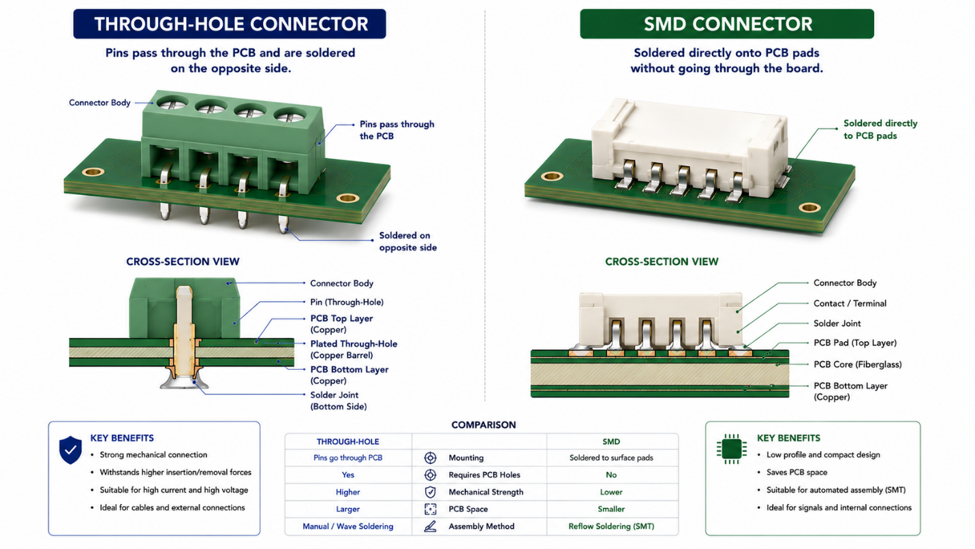
When Through-Hole Connectors Make Sense
Through-hole connectors are commonly chosen when mechanical strength is important.
Applications such as frequently plugged USB cables, external sensors, or power connectors may place repeated stress on the connector. Since the pins pass through the PCB, the mechanical load is shared by both the solder joints and the board itself.
For products that will experience frequent connection and disconnection, this added strength can be an advantage.
When SMD Connectors Are a Better Choice
SMD connectors are often preferred for compact PCB designs and automated assembly.
Because they are mounted directly on the PCB surface, they help reduce manufacturing time and allow more flexibility when routing traces on multilayer boards.
For lightweight connectors that are not subjected to significant mechanical force, an SMD version is often a practical choice.
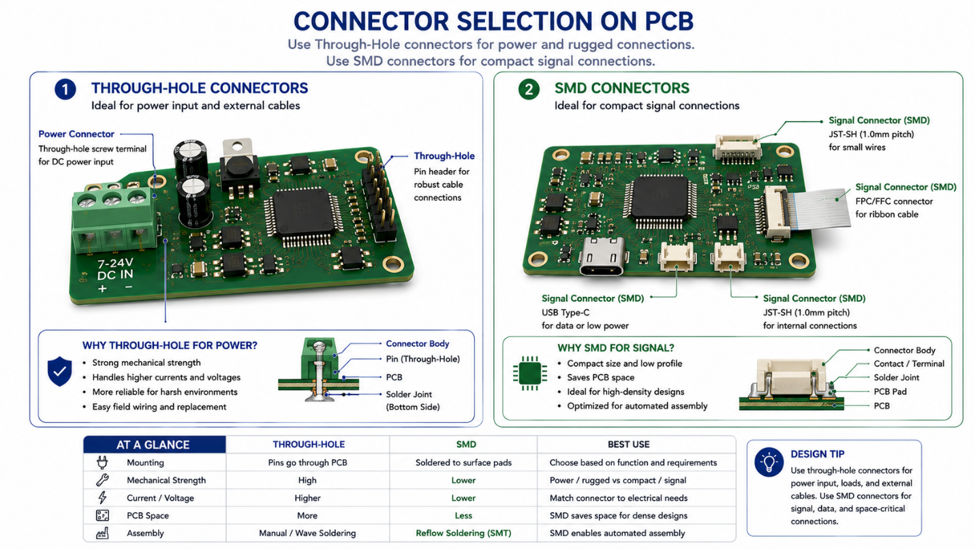
Consider the Final Product
Instead of asking which connector type is better, consider how the product will be used.
Questions such as these can help guide the decision:
- Will users frequently plug and unplug cables?
- Is the PCB installed inside a fixed enclosure?
- Will the product be assembled manually or automatically?
- Is mechanical strength more important than saving PCB space?
Answering these questions early often leads to a more suitable connector selection.
Engineering Tip
Choose the connector based on the application's requirements rather than using the same mounting style for every design. A connector that works well in one product may not be the best option for another.
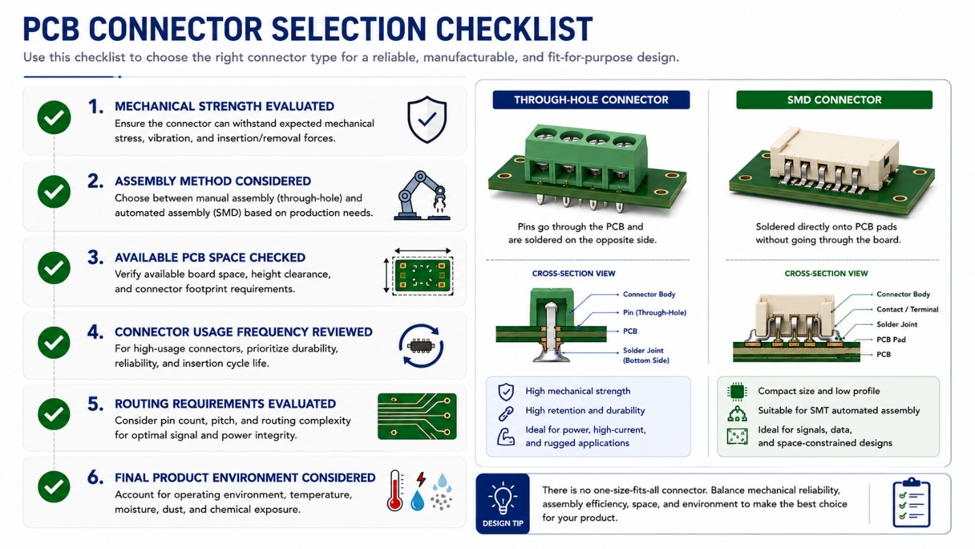
Both through-hole and SMD connectors have important roles in modern PCB design. Selecting the right option depends on the product's mechanical requirements, manufacturing process, and available space rather than following a single design preference.
Choosing the connector that best fits the application can improve both the assembly process and the long-term reliability of the finished product.
#DesignAndManufacturing# #PCBDesign# #Connectors# #SMD# #ThroughHole# #Electronics#
 #DesignAndManufacturing#
#PCBDesign#
#Connectors#
#SMD#
#ThroughHole#
#Electronics#
#DesignAndManufacturing#
#PCBDesign#
#Connectors#
#SMD#
#ThroughHole#
#Electronics#
Sign In Or Register Comment after
No comments yet. Be the first to comment!