


 View
View
Roughly two dollars separates the ESP32-C3 from the ESP32-S3, and that gap decides whether your board can hold a camera frame. The C3 has 400 KB of SRAM and no PSRAM support at all. A single VGA frame or a modest TensorFlow Lite model clears that in one step, so the decision is made before you write any firmware.
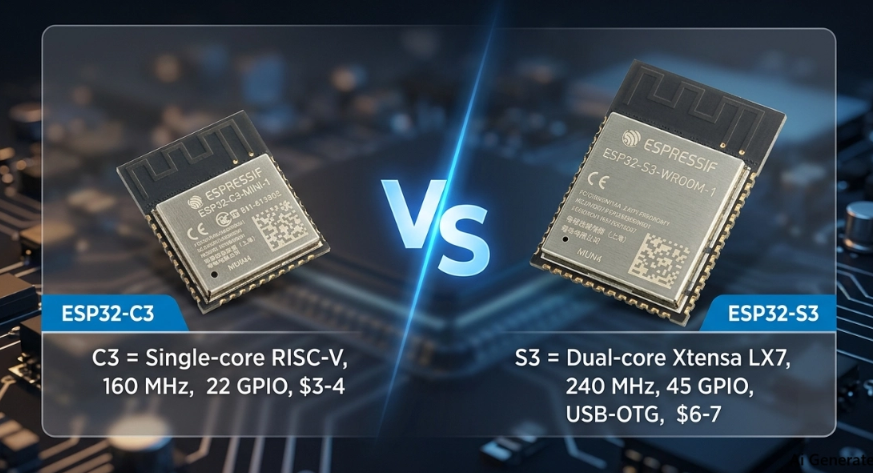
ESP32-C3-MINI-1 and ESP32-S3-WROOM-1 modules side by side with key specs
The Spec Split
Both parts run the same radio, so connectivity never breaks the tie. Everything else does. The C3 is a lean single-core RISC-V part built for cost and battery life; the S3 is a dual-core Xtensa LX7 with PSRAM, USB-OTG, and camera and display interfaces.
· CPU: single-core RISC-V at 160 MHz vs dual-core Xtensa LX7 at 240 MHz
· SRAM: 400 KB vs 512 KB, plus up to 16 MB Octal PSRAM on the S3 only
· GPIO: 22 vs 45
· USB: Serial/JTAG only vs native USB-OTG, host and device
· AI: none vs 128-bit SIMD vector instructions
· Deep sleep: about 5 µA vs about 7 µA
· Price: about $3 to $4 vs about $6 to $7 per module
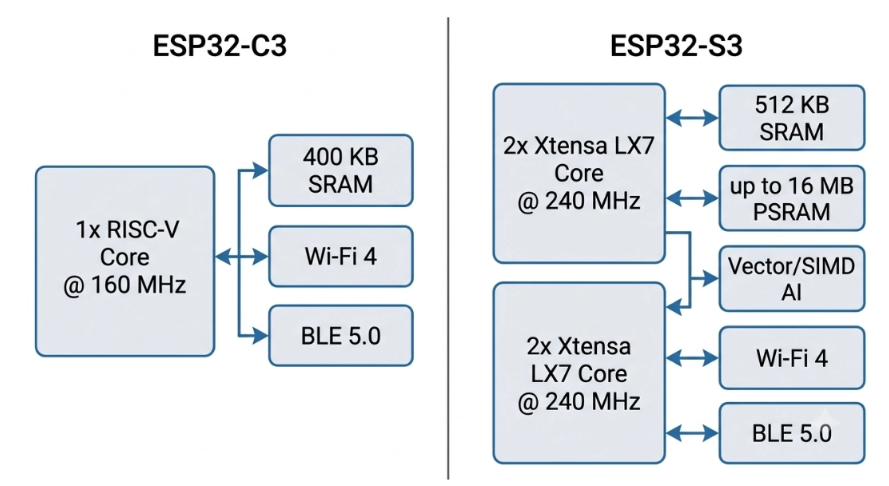
Single-core RISC-V and dual-core Xtensa LX7 block diagrams compared
The Dual-Band Myth
Several ranking articles claim the S3 offers dual-band or 5 GHz Wi-Fi. It does not. Both chips are 2.4 GHz Wi-Fi 4 (802.11 b/g/n) with Bluetooth LE 5.0, with no dual-band, no Wi-Fi 6 and no classic Bluetooth. The same care applies to USB. The C3 does have USB, but only a Serial/JTAG controller for flashing, logging and debugging. It cannot enumerate as a keyboard or mass-storage device, and it cannot act as a host. Full USB-OTG is S3-only.
On The Board
The two modules are not pin-compatible, so swapping the ESP32-C3-MINI-1 for the larger ESP32-S3-WROOM-1 mid-project means a new footprint. Both need the same RF discipline: keep the antenna zone free of copper on every layer and push it to the board edge, hold a continuous stitched ground plane under the module, and decouple close to the 3V3 pins. Two rules are S3-only, namely short length-matched Octal PSRAM traces, and USB D+/D- routed as a 90 ohm differential pair.
The full spec tables, the decision flowchart and the complete PCB layout checklist are in the full comparison: Read the full comparison
Sign In Or Register Comment after
No comments yet. Be the first to comment!